
Reviewed · WALKING TOURS
Vienna: Walking Tour of the MuseumsQuartier with Guide
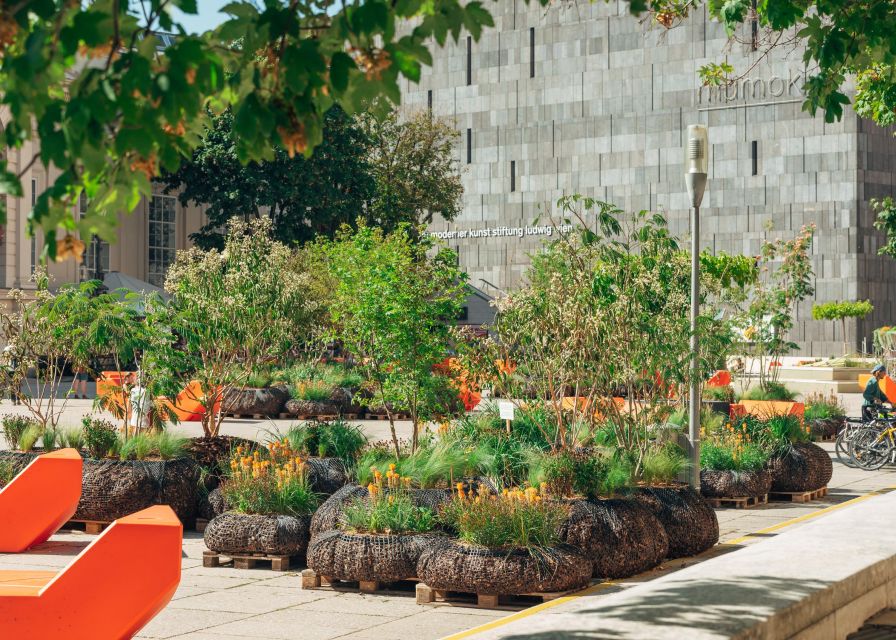
The most surprising part of this one-hour MuseumsQuartier tour is how much story is packed into a place that can first look like a collection of museums, cafés, and open courtyards. Your guide points out details you could easily miss, including the sound made by mumok’s basalt façade and the 2.35 million white dots spread across MQ Libelle’s glass.
I like the $10 price, which makes a guided introduction easy to add to a Vienna day. I also like the human scale: the tour is short, in German or English, and focused on one cultural district rather than trying to cover half the city. The main drawback is that museum admission is not included, so you pay separately if you want to go inside the exhibitions.
- MQ Libelle’s dotted glass: Learn how more than 2.35 million white dots form its shimmering surface.
- A baroque and modern mix: See how older architecture and bold contemporary design share the same public space.
- A detail you can hear: Find out why tapping the basalt slabs on mumok creates a distinctive sound.
- A short, useful orientation: The one-hour length fits neatly before or after museum visits.
- A guide-led experience: Tours run in German or English, with guides such as Tina bringing the district to life.
- Weather-ready planning: The tour operates rain or shine, and umbrellas are provided free of charge.
Why MuseumsQuartier deserves a guided hour
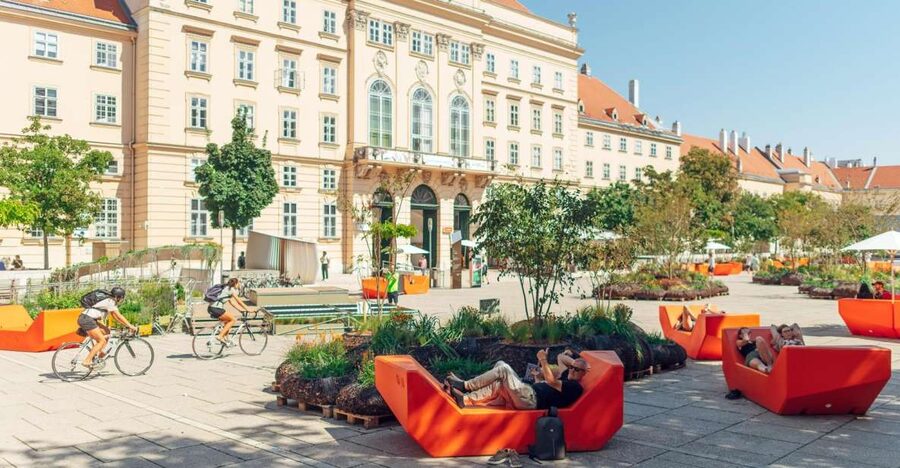
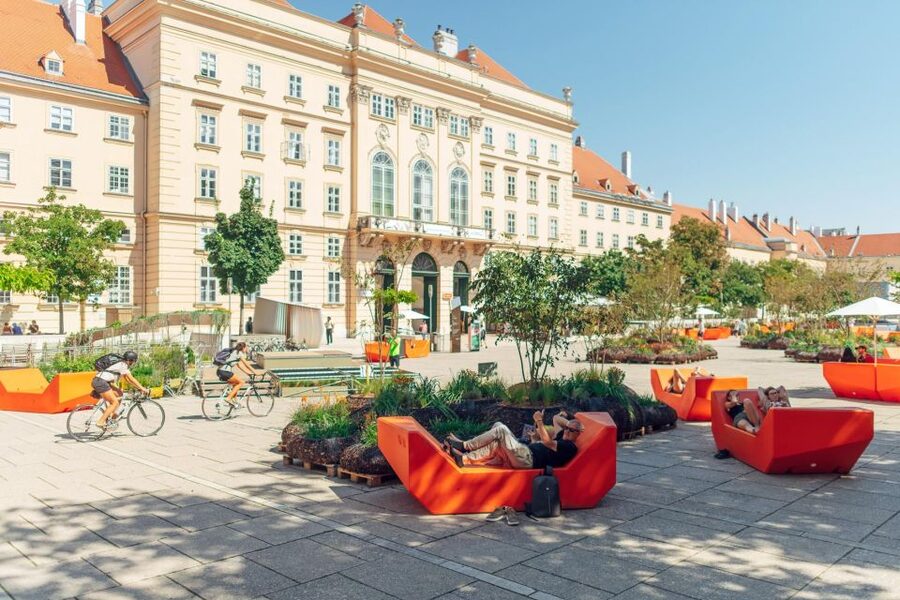
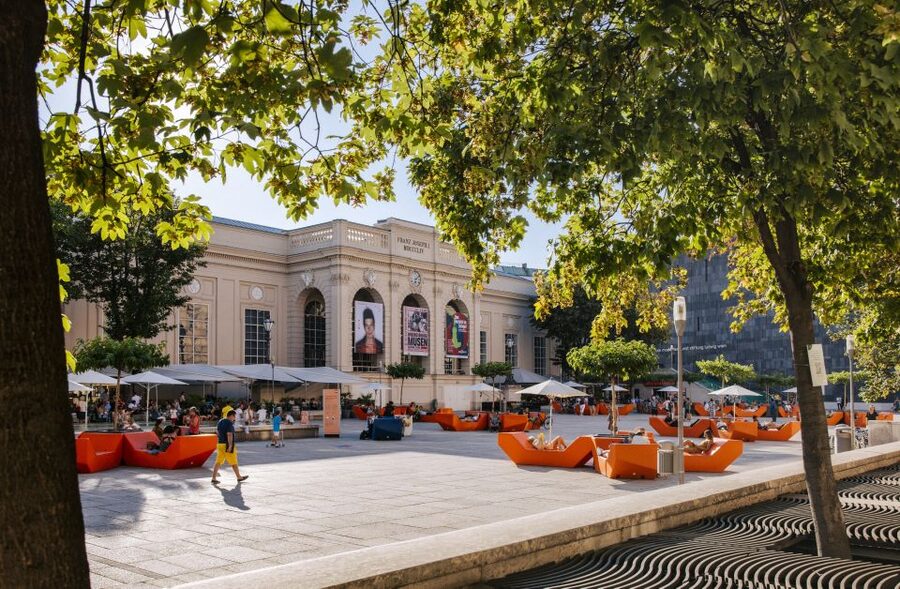
Vienna’s MuseumsQuartier is not simply a row of exhibition halls. It is a large public meeting place where art, architecture, cafés, courtyards, and everyday city life overlap. The district is often called Vienna’s largest living room, and that description makes sense once you pay attention to how people use it.
You are not signing up for a museum marathon. The focus is the district itself, its origins, its design, and its role as a place for exchange and contact. That makes this a good choice if you want context before choosing which museum to enter.
I find this kind of tour useful because MuseumsQuartier can seem easy to understand at first glance. The old buildings suggest imperial Vienna, while the dark, angular forms of newer museums point in another direction. A guide helps connect those pieces instead of leaving you with a few striking façades and no explanation.
The tour also gives you a better sense of the district as a living public space. It is not presented only as a container for art. Its importance comes from the way it encourages people to meet, pause, talk, and move between culture and ordinary city life.
Starting at MQ Point
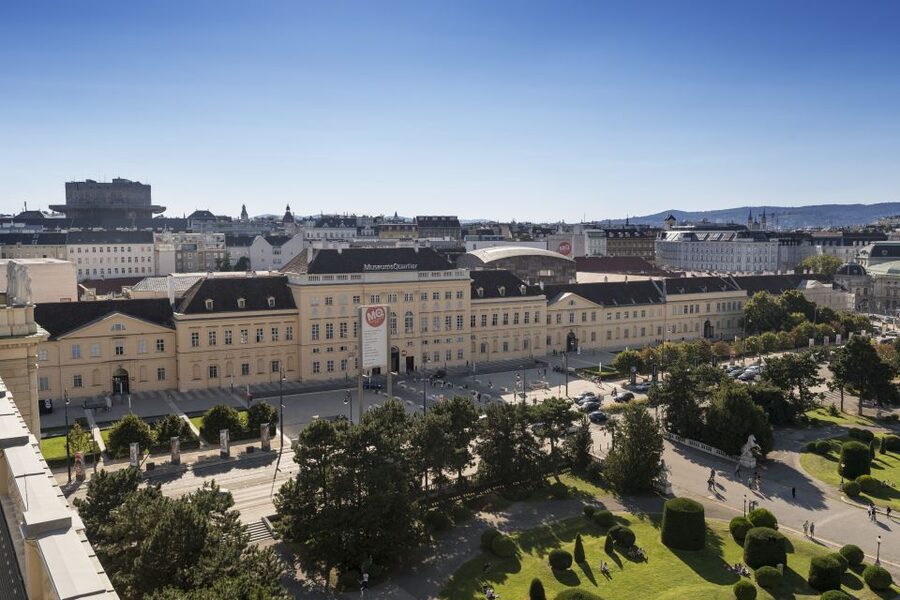
The meeting place is in front of MQ Point. Look for the ground sticker marked Meeting Point. This is a small detail, but it matters in a broad public complex where several entrances and buildings can look alike.
Arrive with enough time to locate the sticker and settle in. The tour lasts one hour, so a late start could cut into a fairly compact program. The exact departure time depends on the date, so check availability when booking.
MQ Point is also a useful reference for the rest of your visit. You can treat the guided hour as your introduction, then decide which parts of the district deserve more time. Since museum tickets are not part of the tour, this arrangement gives you flexibility instead of forcing you into a larger admission package.
The guide speaks either German or English. Tina has led the tour, and her approach has been described as personable, clear, and easy to follow. Other guides may lead your departure, but the format remains the same: a live guide, a shared walk, and an explanation of the district’s design and purpose.
More Walking Tours in Vienna
- Vienna: Guided Walking Tour of City Center Highlights
★ 4.7 · 4,989 reviews - Vienna: Vienna Central Cemetery Guided Walking Tour
★ 4.8 · 3,307 reviews - Vienna: Guided Walking Tour of City Highlights & Hidden Gems
★ 4.9 · 2,180 reviews
Reading the mix of baroque and modern architecture
One of the best reasons to take this tour is the contrast between old and new. MuseumsQuartier brings baroque architecture together with contemporary museum buildings and public installations. On your own, you may notice the contrast. With a guide, you get help understanding why it matters.
The older buildings connect the area to Vienna’s long cultural tradition. The newer structures do not attempt to copy them. Instead, they create a sharper visual conversation through dark materials, hard lines, glass, and open public areas.
That contrast is especially useful for anyone interested in architecture but not trained in it. The tour is designed for a general audience, so you do not need specialist knowledge to follow the explanations. The guide makes the ideas practical and visible rather than turning the hour into a technical lecture.
I would pay close attention to how the buildings affect the public space around them. The point is not just to identify one attractive façade after another. You are looking at how a cultural district can combine monumental older structures with places meant for casual use and modern artistic work.
The basalt sound at mumok
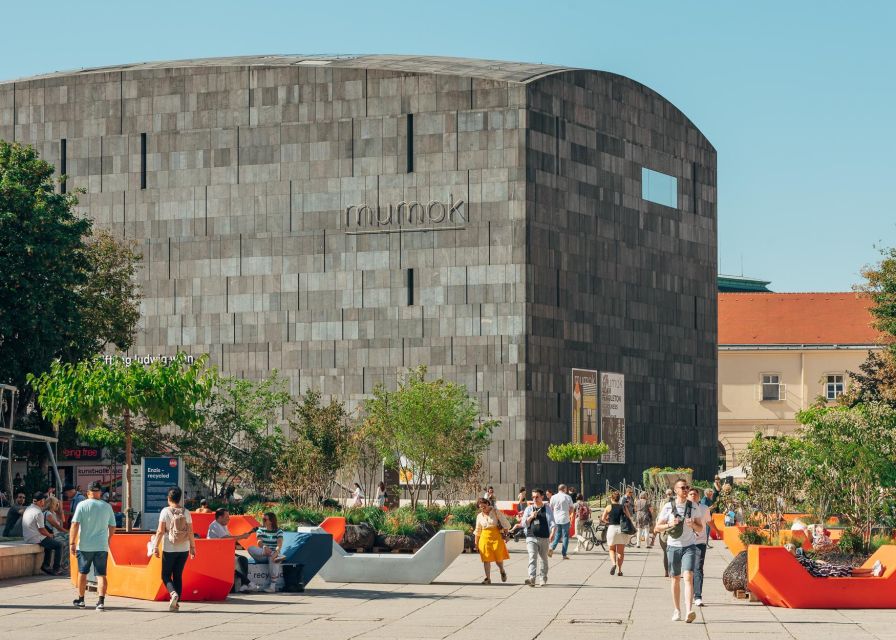
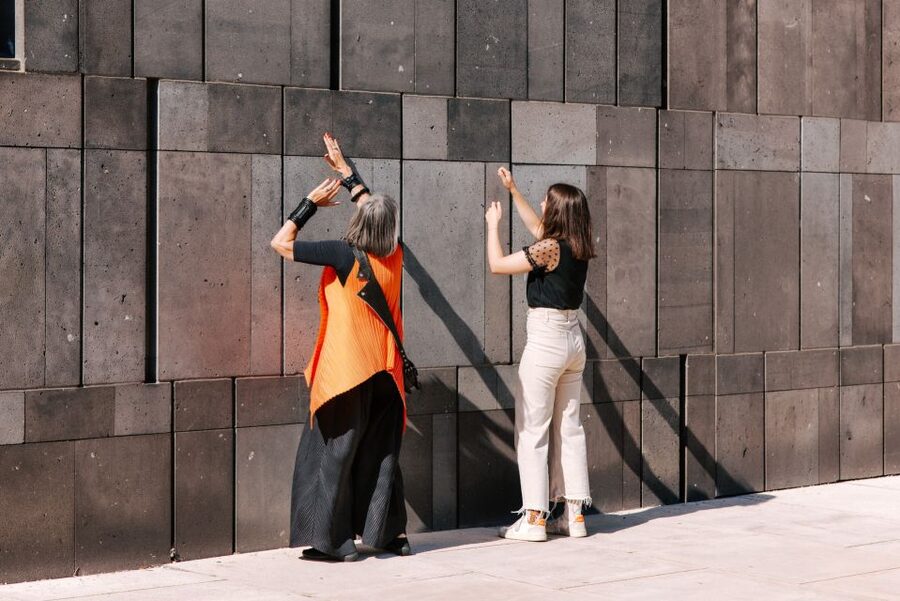
Mumok, the Museum moderner Kunst Stiftung Ludwig Wien, offers one of the tour’s most memorable details. Its façade is covered with basalt slabs, and tapping them produces a distinctive sound.
This is exactly the sort of small feature that makes a guided walk worthwhile. You might pass the dark façade and register its shape, but you are unlikely to know that the surface can be heard as well as seen. The detail gives the building a physical quality that photographs do not convey.
Your guide explains the feature during the walk. If tapping is demonstrated, listen for the difference between this surface and an ordinary wall. It is a brief moment, but it changes the way you read the building.
The tour does not include admission to mumok or any other museum at MuseumsQuartier. That is both a limitation and an advantage. You will not see the galleries or exhibitions during this hour, but you can use the information to decide if you want to return with a separate ticket.
MQ Libelle and the cultural terrace
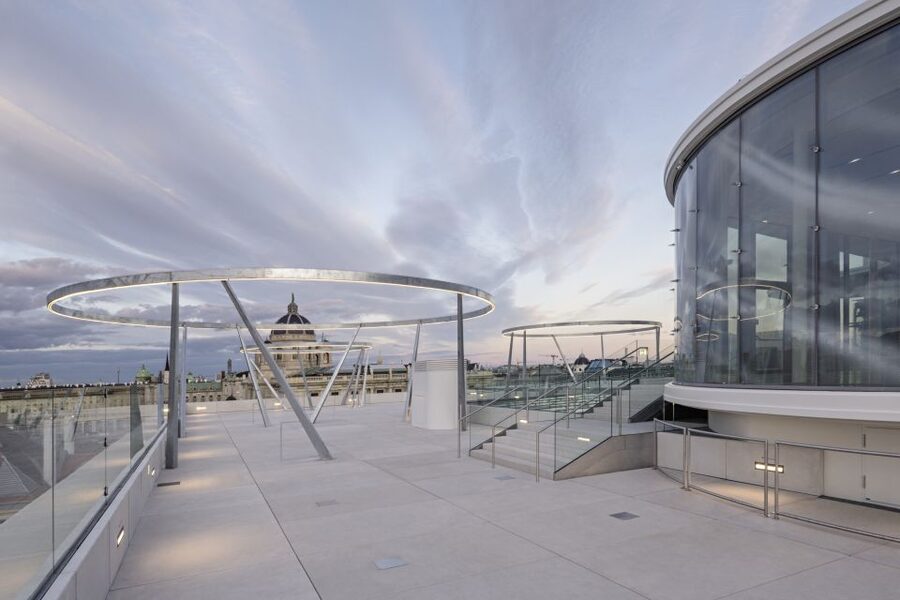
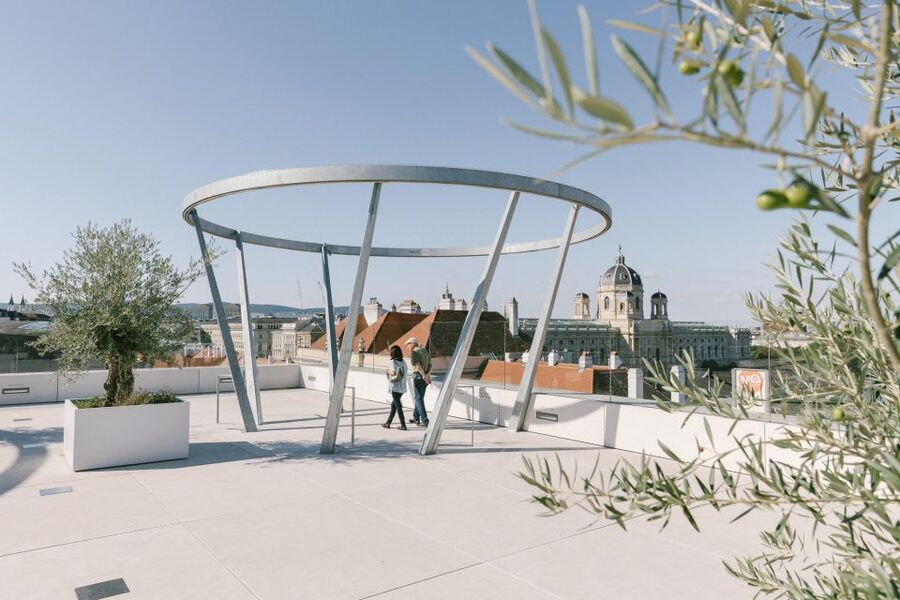
MQ Libelle is one of the district’s major contemporary features. Its glass surface is covered with more than 2.35 million white dots, creating a mesh-like effect that changes the appearance of the structure as you look at it.
The number is so large that it is hard to picture without seeing the building. The dots are not just decoration. They give the glass a shimmering, patterned appearance and make MQ Libelle a clear example of how the district uses design to create a public landmark.
The tour also introduces the cultural terrace connected with MQ Libelle. The emphasis is on the structure’s architectural role and the public setting around it, rather than a museum collection. That makes this part appealing even if you are not planning to visit an exhibition.
Take your time with the views and surfaces here, but keep expectations in check. The experience is a guided look at the terrace and architectural feature, not a separate rooftop attraction with a long visit built into the schedule. The full tour remains one hour.
More walking routes in Vienna:
- Vienna: Viennese Underworld Guided Walking Tour
★ 4.7 · 1,865 reviews - Vienna: World War II Historical Walking Tour
★ 4.8 · 1,772 reviews - Vienna Historic Center Small Group Walking Tour
★ 5.0 · 1,746 reviews - Vienna: Private Walking Tour with a Local Guide
★ 4.6 · 1,420 reviews
The story behind a cultural district
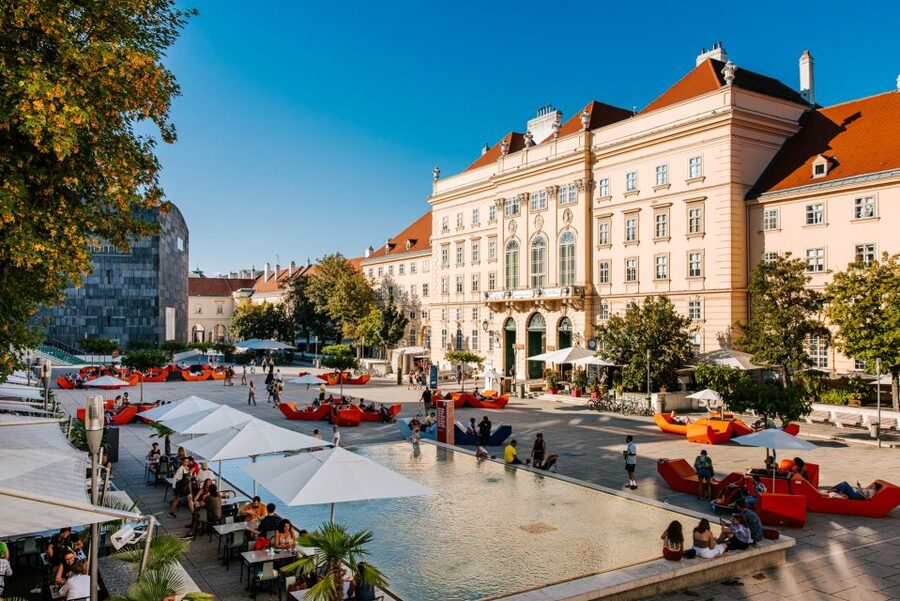
Your guide explains how MuseumsQuartier developed and why it matters today. The district’s story is not treated as a simple march from old buildings to new ones. The focus is on how the area became a place for art, ideas, encounters, and different forms of public life.
That context helps you understand the district beyond its name. MuseumsQuartier is not only about entering a museum, spending a few hours inside, and leaving. It also works as a shared urban room, a place where people can gather without needing to buy a ticket for every moment.
This is where the tour offers more than architectural sightseeing. You hear about the role of the area as a meeting point and a place for diversity. The guide connects the buildings with the way the district is used now.
I especially appreciate that the tour keeps the subject tied to present-day Vienna. You are not given a history lesson detached from modern life. Instead, the guide explains why this area still matters as a space that changes with the people using it.
What the one-hour schedule feels like
One hour is enough to give you a clear introduction, but not enough to cover every museum, building, exhibition, or corner of the district. That is important when deciding how to fit it into your day.
The pace should suit you if you like a focused walk with regular explanations. You get a broad look at the district, then you can return to specific sites on your own. If you prefer slow photography, long pauses, or detailed interior visits, the schedule may feel tight.
I would place this tour at the beginning of your MuseumsQuartier visit. The information about mumok, MQ Libelle, and the district’s design can shape what you notice afterward. It also prevents you from spending your first hour simply wandering among buildings without knowing what you are seeing.
You can also take it after visiting a museum, especially if you want the larger setting explained. In that case, the walk helps pull your museum experience back into the wider cultural district.
Weather, comfort, and accessibility
The tour operates rain or shine. Free umbrellas are provided, which is a practical touch in Vienna, where a wet forecast can change your plans quickly. One person who took the tour in rainy conditions received an umbrella to borrow from the gift shop, and the guide adjusted the presentation to suit the weather.
You should still dress for an outdoor walk. The exact amount of time spent outside is not specified, but the tour is a walking exploration of the district, and the weather policy confirms that conditions matter.
The activity is wheelchair accessible. That makes it a useful option for people who want a guided introduction without assuming that every participant can manage stairs or difficult access. For highly specific mobility questions, confirm the current route when booking, since individual conditions and temporary changes can affect access.
The live guide format is another comfort factor. You can ask questions during the hour instead of relying only on signs or an audio recording. The German and English options also make it easier to choose a departure that fits your language needs.
What the $10 price really offers
At $10 per person, this is an inexpensive guided experience by Vienna standards. The value comes from interpretation, not from admission to a major attraction. You are paying for an informed introduction to a large cultural district and for the chance to notice details that are easy to miss.
That price works particularly well if you already plan to visit MuseumsQuartier. You can take the tour, then buy only the museum ticket that interests you. It is a more flexible approach than purchasing several admissions simply because they are bundled together.
The price is less compelling if you want a full museum visit during the same hour. No gallery admission is included, and the tour itself does not replace time inside mumok or the other museums. Think of it as a short orientation and architecture walk.
You can reserve now and pay later, which helps if your Vienna schedule is still shifting. Cancellation is free up to 24 hours in advance for a full refund. Those terms reduce the risk of booking a short activity around uncertain plans.
Who will get the most from this tour
I would recommend this tour to first-time visitors who want to understand MuseumsQuartier before choosing where to spend their museum time. It also suits returning visitors who have seen the buildings but never learned how the district works as a public space.
Architecture fans will enjoy the contrast between baroque forms and contemporary design. The basalt detail at mumok and the dotted glass of MQ Libelle give you specific things to look for, rather than a general talk about buildings.
Families and mixed-interest groups may also find the format useful. One hour is short enough not to exhaust anyone, and the subjects are visual and practical. The basalt sound and the enormous number of dots on MQ Libelle give younger participants something concrete to notice.
I would hesitate only if your priority is a long museum visit or a very slow walking pace. The tour gives you an overview, not a deep examination of individual collections. Since admission is separate, budget both the $10 guide fee and any museum tickets you want.
Is this MuseumsQuartier tour worth booking?
Yes, if you want a low-cost, well-focused introduction to one of Vienna’s major cultural areas. The strongest reasons to book are the short duration, the $10 price, the German and English guide options, and the small architectural details you may otherwise miss.
Book it early in your MuseumsQuartier day if you want help choosing museums afterward. Skip it if you already know the district well and would rather spend the hour inside an exhibition.
The tour is at its best when you treat it as a key to the area, not as a replacement for the museums. You leave with a clearer sense of why the district combines old and new architecture, how MQ Libelle fits into the public space, and why MuseumsQuartier functions as more than a collection of cultural buildings.
FAQ
How long does the MuseumsQuartier walking tour last?
The guided tour lasts one hour.
How much does the tour cost?
The listed price is $10 per person.
What language is the tour offered in?
The live tour guide speaks either German or English.
Is museum admission included?
No. Admission to the museums at MuseumsQuartier is not included.
Where does the tour meet?
Meet in front of MQ Point. Look for the ground sticker marked Meeting Point.
Is the tour wheelchair accessible?
Yes, the activity is wheelchair accessible.
Does the tour run in bad weather?
Yes. The tour operates rain or shine, and umbrellas are provided free of charge.
Can I cancel for a full refund?
Yes. You can cancel up to 24 hours in advance for a full refund.
Can I reserve the tour and pay later?
Yes. You can reserve your place and pay later, allowing you to keep your Vienna plans flexible.
Just added in Vienna
- World War II History Vienna Old Town Private Walking Tour★ 4.8 · 9 reviews
- Vienna: Wine Tasting Tour★ 4.8 · 61 reviews
- Vienna: Winery and Wine Tasting Tour with a Wine Expert★ 5.0 · 5 reviews
- Vienna: Wiener Schnitzel and Strudel Cooking Class★ 4.9 · 126 reviews
- Vienna: Wine Tasting E-Bike Tour★ 4.9 · 46 reviews
- Vienna: Wine Tasting at Schönbrunn Palace★ 4.3 · 71 reviews
- Vienna: Unforgettable Private City Tour★ 5.0 · 7 reviews
- Vienna Urban Art Tour: Explore a different side of Vienna!★ 3.8 · 14 reviews
Walking Tours, compared.
Guided Walking Tour of City Center Highlights
Read our review →
Guided Walking Tour of City Highlights & Hidden Gems
Read our review →
Vienna Historic Center Small Group Walking Tour
Read our review →
Browse the lists this tour appears in