
Reviewed · WALKING TOURS
Vienna: Historical Walking Tour – Hitler and the 1900s
Vienna’s early 1900s were packed with sharp turns: imperial power, new art, political tension, and the young Adolf Hitler trying to find a place in the city. This walking tour ties those threads together, taking you from Hitler’s early Vienna to the cultural changes linked with Klimt and Wagner.
I like the focus on places such as Karlsplatz and Museumsquartier, where architecture and public life help explain Vienna’s move beyond its Habsburg past. I also like the human touch from guides such as Joseph and Cristina, whose storytelling is praised for its anecdotes and clear delivery. The main drawback is the subject matter: this is a serious historical walk, not a light sightseeing stroll, and two hours can only sketch some of the larger events.
Key points to know before you book
- Hitler’s formative Vienna: Follow the places and political setting connected with his early years in the city, without treating the subject as a simple biography.
- Karlsplatz and Museumsquartier: Use two major city areas to see how Vienna shifted from imperial planning toward modern cultural life.
- Klimt and Wagner: Connect architecture, art, and changing ideas in the early 1900s.
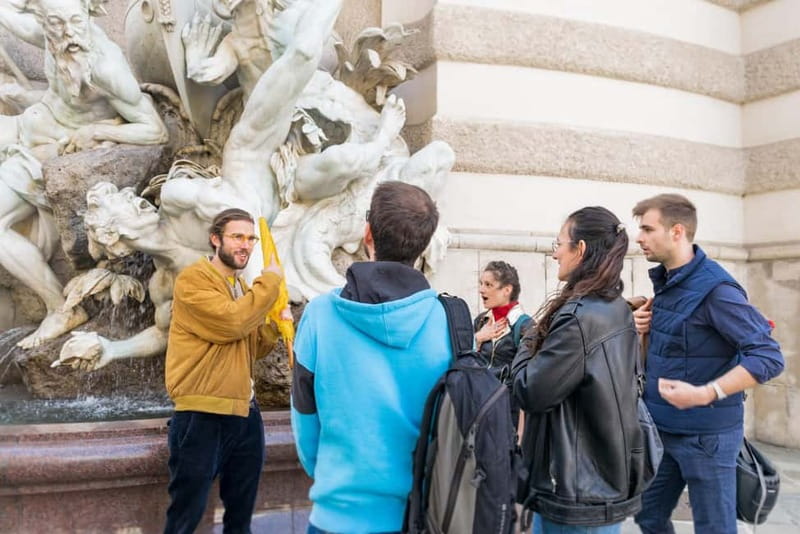
- English-speaking local guide: Guides such as Joseph and Cristina bring anecdotes and personal explanations to the route.
- Two-hour format: A useful first look at the topic, though not long enough for a full study of every site.
- $22 price: Good value if you want historical context and a guided introduction rather than museum entry.
Why this tour gives Vienna a sharper edge
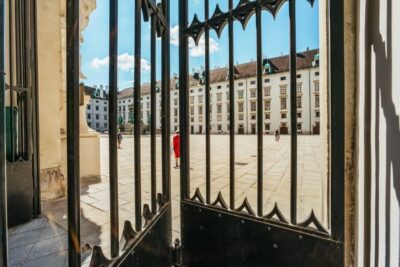
Many walking tours present Vienna through palaces, grand churches, cafés, and music. Those are important, but this route asks a less comfortable question: what was happening beneath the imperial surface as the city entered the 20th century?
You look at Vienna during a period when old power structures were under pressure. The Habsburg Empire still shaped public life, yet artists, architects, and political movements were pushing in new directions. That tension gives the walk its purpose.
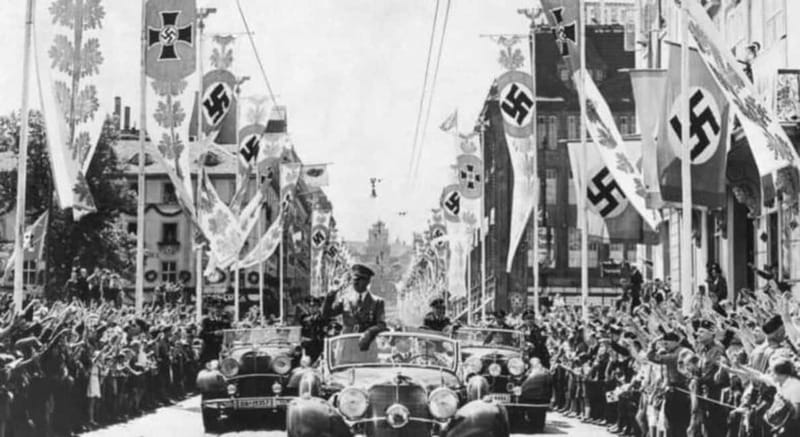
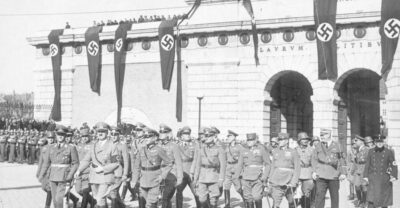
The Hitler section requires care. The tour follows his early life in Vienna and considers how the city influenced his later path. That does not mean the walk can explain every part of his later life, nor should it turn him into the only subject. The value lies in placing his formative years beside the city’s wider social and cultural changes.
You also get a look at the artistic revolution linked with Gustav Klimt and Otto Wagner. Their work helps show that Vienna was not simply preserving imperial traditions. It was also testing new forms, new buildings, and new ideas about what a modern city could be.
More Walking Tours in Vienna
- Vienna: Guided Walking Tour of City Center Highlights
★ 4.7 · 4,989 reviews - Vienna: Vienna Central Cemetery Guided Walking Tour
★ 4.8 · 3,307 reviews - Vienna: Guided Walking Tour of City Highlights & Hidden Gems
★ 4.9 · 2,180 reviews
Starting beneath the yellow Prime Tours umbrella
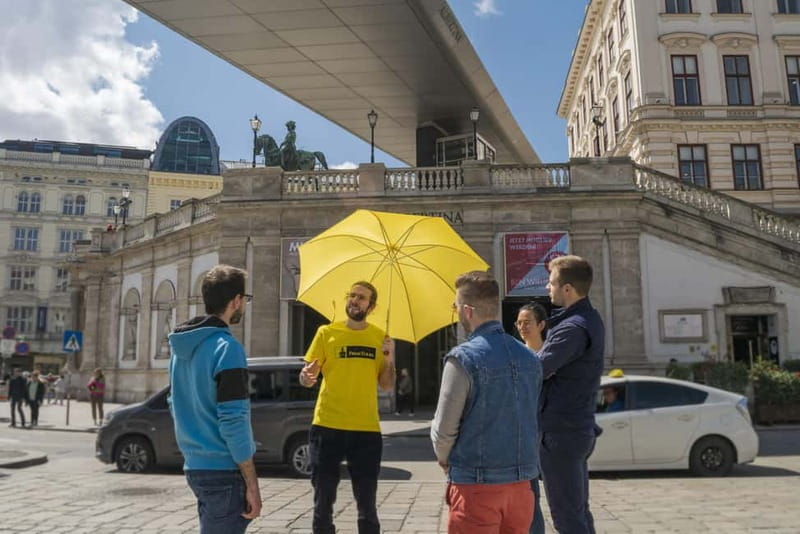
Finding the group should be simple. Look for the yellow Prime Tours umbrella at the meeting point. The tour begins and ends at that same location, so you do not need to plan a separate return journey.
Transportation to the meeting point is not included. You should allow enough time to reach it on your own, particularly if you are coming from another part of Vienna. Since starting times vary, check the selected date before booking and arrive ready for two hours on foot.
The booking includes an expert local guide, a reserved place, instant confirmation, and tips for the city. Food, drinks, museum admissions, and other attraction fees are not included. That matters because the tour is designed as a guided outdoor experience, not as a package with indoor visits.
The guide’s tip is also not treated as a fixed part of the price. The information says more on-the-spot is welcome, so carry some extra cash if you feel the guide gave you a useful and engaging walk.
Hitler’s early years in Vienna
The first major theme is Hitler’s time in Vienna. This part gives you a way to examine his early life in context rather than treating the city as a backdrop.
Vienna at the turn of the century was a place of sharp contrasts. Imperial authority and ceremony remained visible, while modern political movements and artistic experiments were changing how people saw society. A young person trying to make a life here would encounter both the grandeur of the capital and the pressures of a city in transition.
The tour’s focus is not just on where Hitler went. It also looks at how his time in Vienna influenced his later life. That approach makes the subject more useful for you because it links personal biography to the city’s politics and culture.
Expect a thoughtful section rather than a celebration of dark tourism. The description emphasizes controversial history, early influences, and the city’s transformation. If you want a tour that avoids difficult subjects, this is not the right choice. If you want to understand how Vienna’s early 1900s shaped competing political and cultural currents, this is the central reason to book.
The two-hour limit is worth keeping in mind. The guide can offer context and stories, but the walk cannot cover every part of Hitler’s early life or every political movement in Vienna. Think of it as a compact introduction that may give you better questions for further museum visits or reading.
Karlsplatz and the break from imperial Vienna
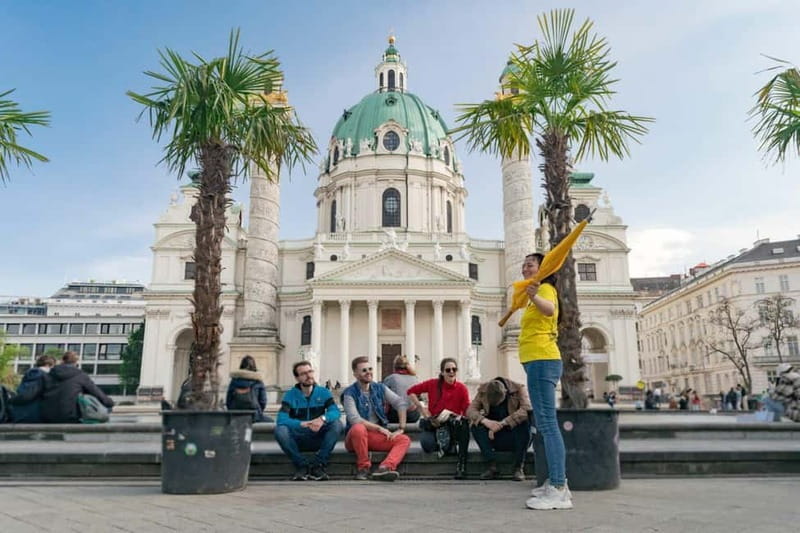
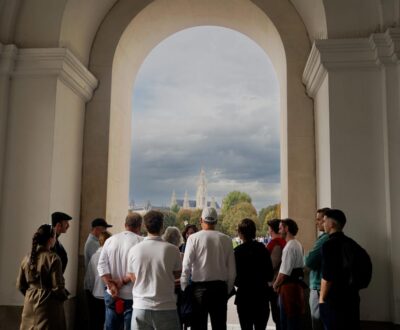
Karlsplatz is one of the route’s important stops. It helps connect Vienna’s grand imperial image with the city’s shift toward modern design and public life.
A place like Karlsplatz works well on a tour of this kind because it lets you read the city through its buildings and open spaces. Your guide can explain how architecture reflects political power, civic ambition, and changing taste. The stop is not simply about taking a photograph. It gives you a physical example of Vienna’s changing identity.
The route also considers the city’s movement from the Habsburg Empire to a modern metropolis. That transition was not sudden. Old structures continued to shape Vienna, even as new art and new political ideas began to challenge them.
I like this part because it gives the tour a wider frame. Hitler’s early years matter, but they are only one thread. Karlsplatz helps you see the city as a place where several stories were unfolding at once.
You should not expect entry into every landmark along the way. Entrance fees are not included, and the tour is primarily a walking route through historic areas. If a museum or attraction catches your interest, you can plan to return independently.
More walking routes in Vienna:
- Vienna: Viennese Underworld Guided Walking Tour
★ 4.7 · 1,865 reviews - Vienna: World War II Historical Walking Tour
★ 4.8 · 1,772 reviews - Vienna Historic Center Small Group Walking Tour
★ 5.0 · 1,746 reviews - Vienna: Private Walking Tour with a Local Guide
★ 4.6 · 1,420 reviews
Museumsquartier and Vienna’s artistic revolution
Museumsquartier adds the cultural side of the tour. The route uses this area to explore Vienna’s artistic changes and the city’s movement toward modern cultural life.
Klimt and Wagner are key names here. Klimt represents the period’s bold artistic shift, while Wagner is tied to architecture and the design of modern Vienna. Their work helps you see why the early 1900s were more than a political turning point. They were also a time when artists and architects questioned older rules.
Your guide’s role matters most at stops like this. Buildings and public spaces cannot explain themselves fully. A clear story can show you what changed, why it mattered, and how the city’s imperial past still shaped the new work.
The tour also promises lesser-known places and stories beyond the standard route. Since the exact stop list is not provided, you should not expect a fixed museum schedule or a detailed account of every building. Instead, you get a guided walk that connects selected sites into one historical story.
That makes the route useful early in your Vienna visit. You can later return to the museums or architectural sites that interest you most, now with more context.
What the guides add to the walk
The guide can make or break a history tour, and the strongest comments here focus on storytelling. Joseph is praised for sharing many anecdotes and interesting stories. Cristina is described as clear and well spoken, with enough command of the subject to hold attention beyond the scheduled walk.
Another guide, Ángeles, is also associated with a tour praised for its explanation of Vienna’s history. The repeated pattern is useful: you are not simply being led from one address to another. You are getting a spoken interpretation of the city.
The tour is conducted in English. That keeps the experience accessible to English-speaking visitors, but you should still be ready for historical names, political terms, and references to early 20th-century culture.
An anecdote can make a place memorable, but it is not a substitute for complete historical coverage. The best way to use this tour is to listen for the main connections, note the sites you want to revisit, and ask questions when the guide allows time.
The guide’s local perspective is especially helpful for a subject that can easily become abstract. Vienna’s political and cultural changes become easier to follow when they are tied to streets, squares, buildings, and the city you can see around you.
Walking conditions, timing, and access
The tour lasts two hours. That is long enough to build a clear story without taking up an entire day, and short enough to fit beside a museum visit or another central Vienna plan.
Because it is a walking tour, wear comfortable shoes and dress for the weather. The supplied information does not give a distance, pace, group size, or detailed route map, so you should not assume a specific walking speed or the exact number of stops.
The experience is listed as wheelchair accessible. That is useful information, though the route’s individual surfaces and the accessibility of every point are not described in detail. If you have specific mobility needs, confirm the route details before the tour date.
You do not need to arrange transport during the activity. The walk begins and ends at the meeting point. Food and drinks are not supplied, so handle those before or after the two-hour route.
Is $22 a fair price?
At $22 per person, this is a reasonable price for a two-hour guided walk in central Vienna. You are paying mainly for the guide’s interpretation, local context, and the chance to connect several subjects that might otherwise feel separate.
The value is strongest if you enjoy history and want a focused introduction to Vienna’s early 1900s. You get Hitler’s early years, the Habsburg-to-modern transition, architecture, Klimt, Wagner, Karlsplatz, Museumsquartier, and local recommendations in one compact outing.
The value is weaker if you mainly want grand interiors or museum collections. Admissions are not included, and the experience does not promise entry to attractions. You will need to pay separately for museums or return to them later.
At this price, I would treat the tour as a foundation. It can help you decide which sites deserve more of your time, while giving you a better sense of how the city’s past connects to its present.
The reserve-now, pay-later option also helps if your schedule is still changing. You can reserve a spot without paying immediately, and free cancellation is available up to 24 hours before the tour for a full refund.
Who should book this Vienna walk?
I would recommend it to you if you enjoy political history, urban change, and art in equal measure. It suits first-time visitors who want more than a list of imperial landmarks, as well as repeat visitors looking for a different angle on Vienna.
It is also a good fit if you prefer a short activity with a clear theme. Two hours leaves room for a museum, coffee, or another neighborhood afterward.
You may want to skip it if you are looking for a relaxed palace tour, a music-focused route, or a full museum experience. The Hitler subject is central, and the mood is more serious than cheerful.
Solo visitors and couples may appreciate the guide’s stories and recommendations. Families should consider the subject matter and the children’s age before booking. The tour is marked wheelchair accessible, but anyone needing detailed mobility information should confirm the route in advance.
Final verdict: book it for context, not just landmarks
Book this tour if you want Vienna’s famous squares and cultural sites to make more sense. The best parts are the connection between Hitler’s early life and the city around him, the look at Klimt and Wagner, and the guide-led stories that bring places such as Karlsplatz and Museumsquartier into one timeline.
The main limitation is scope. Two hours cannot cover every building, event, or political cause in Vienna’s early 1900s, and museum entry is not included. Still, $22 is fair for a focused English-language introduction, especially with guides such as Joseph and Cristina bringing anecdotes and clear explanations to the route.
FAQ
How long does the walking tour last?
The tour lasts two hours.
What language is the tour conducted in?
The tour is conducted in English with a live guide.
Where does the tour start?
Meet the guide by looking for the yellow Prime Tours umbrella. The exact meeting point should be checked in your booking details.
Where does the tour end?
The activity ends back at the meeting point.
Is the tour wheelchair accessible?
Yes, the activity is listed as wheelchair accessible.
Are museum entrance fees included?
No. Entrance fees to museums and other attractions after the tour are not included.
Are food and drinks included?
No. You need to arrange your own food and drinks.
Can I cancel for a full refund?
Yes. You can cancel up to 24 hours in advance for a full refund.
Can I reserve the tour and pay later?
Yes. The reserve-now, pay-later option lets you book a spot without paying at the time of reservation.
More Historical Tours in Vienna
- Vienna: Time Travel and Magic Vienna History Tour
★ 4.6 · 3,879 reviews - Time Travel-Magic Vienna History Tour Ticket
★ 4.5 · 1,099 reviews - Skip-the-Line Schonbrunn Palace Guided Tour and Vienna Historical City Tour
★ 3.5 · 940 reviews - Vienna Mozart Concert in Historical Costumes at the Musikverein
★ 4.5 · 888 reviews
Just added in Vienna
- World War II History Vienna Old Town Private Walking Tour★ 4.8 · 9 reviews
- Vienna: Wiener Schnitzel and Strudel Cooking Class★ 4.9 · 126 reviews
- Vienna: Wine Tasting Tour★ 4.8 · 61 reviews
- Vienna: Winery and Wine Tasting Tour with a Wine Expert★ 5.0 · 5 reviews
- Vienna: Wine Tasting at Schönbrunn Palace★ 4.3 · 71 reviews
- Vienna: Wine Tasting E-Bike Tour★ 4.9 · 46 reviews
- Vienna: Unforgettable Private City Tour★ 5.0 · 7 reviews
- Vienna Urban Art Tour: Explore a different side of Vienna!★ 3.8 · 14 reviews
Walking Tours, compared.
Guided Walking Tour of City Center Highlights
Read our review →
Guided Walking Tour of City Highlights & Hidden Gems
Read our review →
Vienna Historic Center Small Group Walking Tour
Read our review →
Browse the lists this tour appears in