
Reviewed · MOZART & CLASSICAL CONCERTS
Vienna: Mozart, Beethoven, & Strauss Private Tour
Vienna’s musical story comes alive on foot, from the church where Mozart married Constanze to the golden Strauss monument in Stadtpark. This private tour also takes you past the State Opera, Theater an der Wien, the Musikverein, and sites linked with Beethoven and Schubert.
I like the focused route and the chance to shape the conversation around music rather than simply follow a standard Old Town walk. I also like the House of Music finish, where you can conduct a virtual orchestra and compose a waltz instead of only looking at old portraits.
The main consideration is the concert option. It adds a fine evening experience, but the venue and program can change, and your guide does not attend the concert with you. The four-hour walk and museum visit may be the better fit if you want one continuous guided experience.
Key points to know before booking
- Mozart’s wedding church: Begin near St. Stephen’s Cathedral, where Mozart married Constanze.
- Four major composers in one walk: Follow connections to Mozart, Beethoven, Strauss, and Schubert across central Vienna.
- Music venues with real stories: See the Theatermuseum, Vienna State Opera, Theater an der Wien, and the Musikverein.
- Hands-on House of Music visit: Conduct a virtual orchestra, create a waltz, and explore sound through interactive exhibits.
- Optional classical concert: The 5.5-hour version includes a concert in a Viennese church, cathedral, opera house, or concert hall.
- Private guiding in many languages: Tours are available in English, Spanish, French, German, Italian, Russian, Chinese, Japanese, Portuguese, Croatian, and Arabic.
Why this music walk works in central Vienna
Vienna can feel like one large monument to classical music. The names are everywhere, but it is easy to see only plaques and statues without understanding how the composers fit into the city’s daily life.
This tour gives those names a street-level setting. You move through the Old Town and connect famous musicians with churches, theaters, concert halls, parks, and working cultural institutions. That makes the subject easier to follow, especially if you know the music but not the city.
The private format matters here. You are not tied to a large group’s pace or to a fixed lecture. You can ask why Beethoven mattered in Vienna, how Strauss became linked with the waltz, or what made Mozart’s career in the city so important. The guide is described as a music history expert, and Romana received especially warm praise for her passion and ability to bring historical moments to life. The other feedback also points to friendly, engaging guides.
The route is best for someone who wants context, not just a list of composer addresses. You will still see major sights, but the purpose is to understand Vienna as a place where music was performed, commissioned, premiered, taught, and celebrated.
More Classical Concerts in Vienna
- Vienna: Vivaldi’s Four Seasons Concert in Karlskirche
★ 4.7 · 14,951 reviews - Vienna: Classical Concert in the World-Famous Musikverein
★ 4.6 · 6,673 reviews - Vienna: Classical Concert at St. Stephen’s Cathedral
★ 4.1 · 4,177 reviews
Starting at St. Stephen’s Cathedral and Mozart’s Vienna
The meeting point is in front of Hotel Royal at Singerstraße 3, near St. Stephen’s Cathedral. Do not go inside the hotel. This is simply the place to meet your guide.
The cathedral area is an excellent starting point because it puts you in the middle of Vienna’s old center from the first minute. Mozart married Constanze here, giving the opening stop a direct personal link to the composer. It is a useful reminder that these musicians were not distant names in textbooks. They lived, worked, married, performed, and competed in the same streets you are walking.
The cathedral itself is one of Vienna’s major landmarks, but this tour does not present it as a separate cathedral sightseeing visit. The focus is the musical connection and the surrounding Old Town. If you have already toured St. Stephen’s Cathedral, you will still get a new angle on the area. If you have not, you will get an important exterior orientation before continuing through the city.
Because this is a walking tour, comfortable shoes are sensible. The exact route and pace can depend on your guide and your interests, but the supplied duration is four hours for the main option. That is enough time for a meaningful walk and the House of Music, though it is not a quick one-hour introduction.
Theatermuseum, Beethoven, and the city’s opera houses
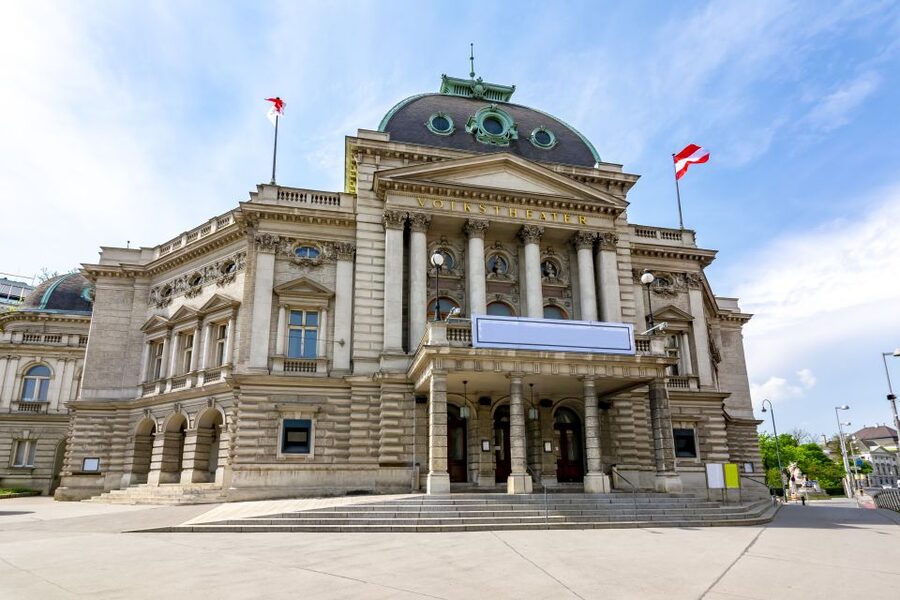
One of the more distinctive stops is the Theatermuseum, associated with a private Viennese premiere of Beethoven’s Third Symphony, known as Eroica. That detail gives the tour a useful sense of place. Beethoven’s career was not only about composing in isolation. His work had to reach audiences, patrons, performers, and venues.
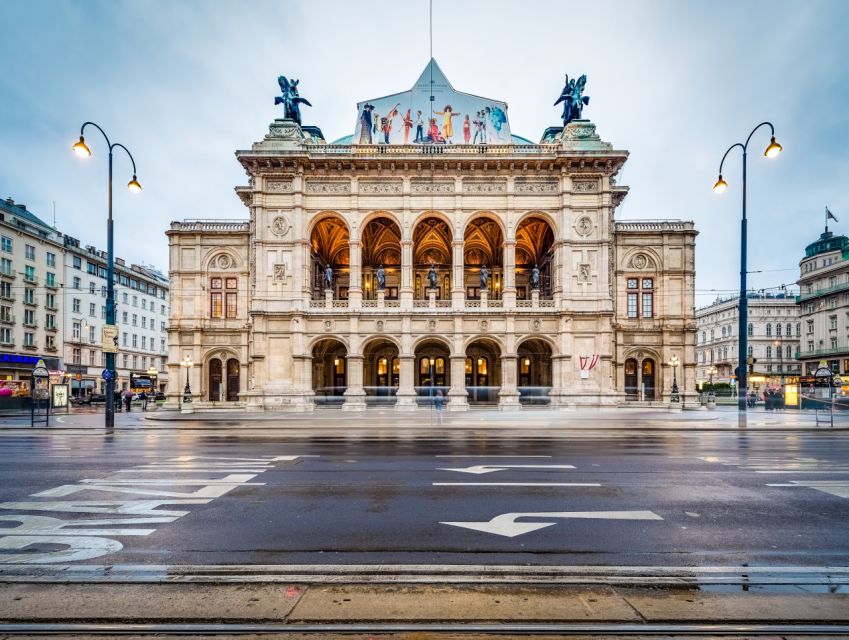
You will also see the Vienna State Opera, one of the city’s most recognizable music buildings. The tour treats it as part of Vienna’s larger performance culture rather than as a standalone photo stop. Your guide can place the opera house within the city’s musical identity and explain why these venues still matter to Vienna.
Theater an der Wien adds another thread, this time tied closely to Johann Strauss. Almost all of Strauss’s operettas had their premieres there, making the theater particularly useful for understanding how popular music and stage entertainment shaped Vienna.
This section should appeal to you if you like the practical side of music history. The route is not only about who wrote a piece. It is also about where music was presented and how Vienna became a city where major premieres could draw attention.
A small limitation is that the tour information does not promise interior visits to these theaters. You should expect to see the buildings and hear their stories, not automatically enter each one. The guaranteed museum entry is for the House of Music.
The Musikverein and Vienna’s concert tradition
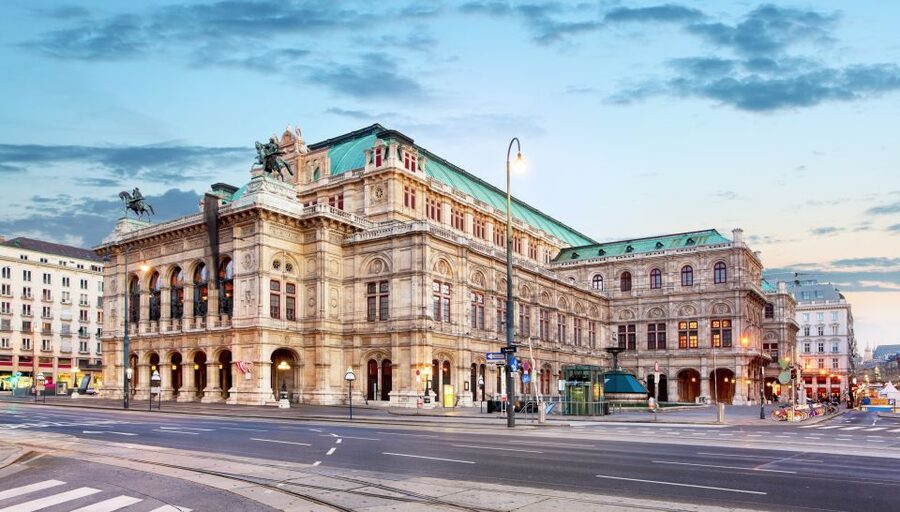
The Wiener Musikverein is another major point on the route. It is home to the Vienna Philharmonic Orchestra, so even a short exterior visit connects the streets of central Vienna with one of the world’s best-known orchestras.
For many people, this is where the tour’s themes come together. Mozart, Beethoven, Strauss, and Schubert are not simply four unrelated names. Their music belongs to a long Viennese performance tradition, and the Musikverein represents the city’s continuing place in that tradition.
The guide can also help you sort out a common Vienna problem: there are many concert venues, many composer statues, and many competing stories. A private guide gives you room to ask which places are tied directly to a composer and which ones represent the city’s broader musical culture.
Do not book this walk expecting an orchestra performance at the Musikverein as part of the four-hour option. The concert is a separate feature of the longer 5.5-hour choice, and the concert venue can be a cathedral, church, opera house, or concert hall elsewhere in the Old Town.
Other concert evenings in Vienna:
- Vienna: Mozart Concert at the Golden Hall
★ 4.6 · 3,986 reviews - Vienna: Classical Concert in St. Anne’s Church (Annakirche)
★ 4.6 · 3,414 reviews - Vienna: Classical Concert at Mozart’s First House
2,423 reviews - Vienna: Mozart and Strauss Concert at Schönbrunn
★ 4.5 · 2,364 reviews
Stadtpark’s composer meeting point
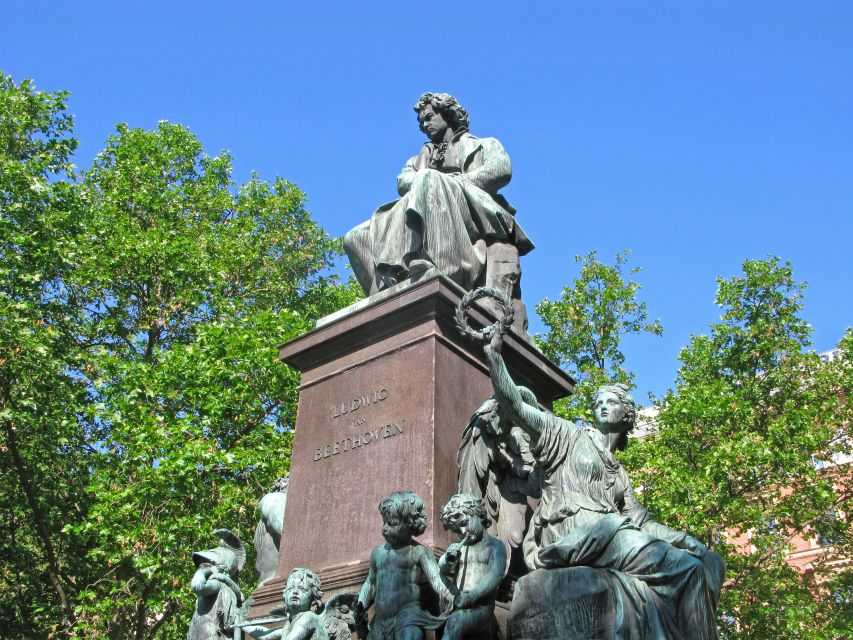
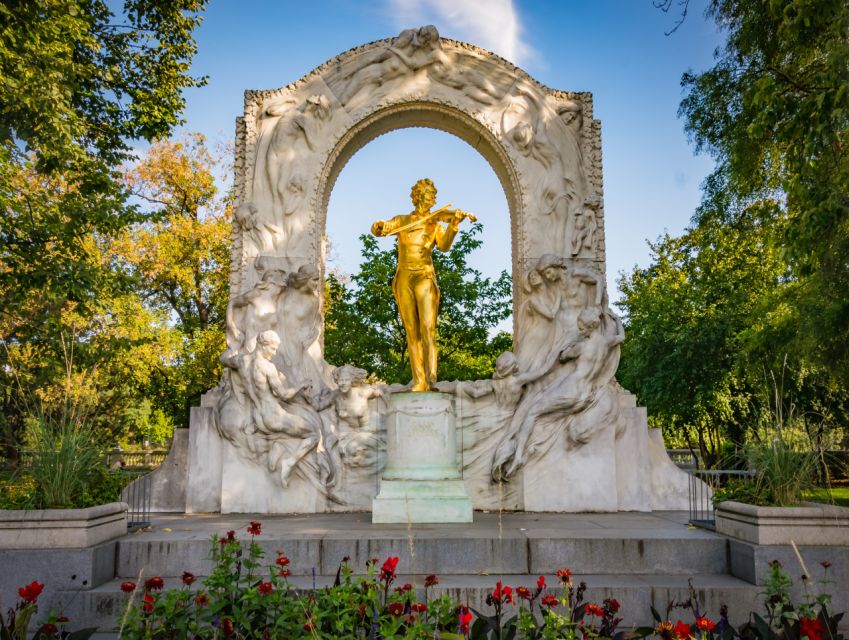
Stadtpark provides a welcome change from the dense streets of the Old Town. Here you find the famous golden monument to Strauss, along with statues of Beethoven and Schubert. It is an unusually efficient stop: three important figures connected to Vienna appear in one park.
The Strauss monument is one of the city’s most recognizable music-themed sights, and it makes a good photo stop. Yet the park is more than a place for a quick picture. Seeing Strauss beside Beethoven and Schubert lets you compare different chapters of Vienna’s musical life in one setting.
This part of the route may be especially helpful if you do not know the composers equally well. Mozart and Beethoven often dominate first-time Vienna sightseeing, while Schubert can receive less attention. The park creates a natural opening for the guide to explain how each composer fits into the city’s story.
The stop also breaks up the indoor and theater-focused parts of the walk. You get space, fresh air, and a chance to reset before the final museum visit.
House of Music: the tour’s most playful stop
The final stop on the standard route is the House of Music, where skip-the-line entry is provided when that option is selected. This is not a quiet collection of framed manuscripts. The museum uses interactive displays to explain sound, composition, orchestras, and famous musicians.
You can try the Virtual Conductor, compose your own waltz, and explore exhibits about Mozart and other major figures from Vienna. That makes the museum a smart finish after a history-heavy walking route. Instead of ending with another statue or building, you get a chance to test your own musical instincts.
I particularly like this balance for families and mixed-interest groups. A serious music fan can spend time with the historical material, while someone less comfortable with classical music gets an active way into the subject. It also gives children something to do beyond listening to names and dates.
The phrase skip-the-line means you receive entry without waiting in the regular ticket queue. It does not mean the museum will be empty or that every exhibit will be available at all times. Still, avoiding a separate ticket purchase and queue is useful, especially after several hours on foot.
If you are choosing between a standard city walk and this tour, the House of Music is one of the strongest reasons to pick this one. It turns the final hour into participation rather than passive sightseeing.
Choosing the 4-hour walk or the 5.5-hour concert option
The four-hour option is the cleaner choice if you want a guided Old Town route, composer landmarks, and the House of Music. It gives you a substantial half-day activity without committing the rest of your evening.
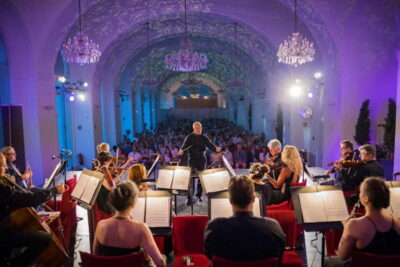
The 5.5-hour version adds a classical concert. Performances may take place in a Viennese cathedral, church, opera house, or concert hall, and the program may include music by Mozart, Beethoven, Strauss, or Schubert. The exact venue and selection depend on the date, time, group size, and availability.
That uncertainty is worth understanding before you pay for the longer version. You are buying access to a classical concert experience, but not a guaranteed named venue or fixed program based on the information provided. If you are set on hearing a particular work in a particular hall, this option may not give you that level of control.
The guide will not accompany you at the concert. That is normal for this kind of arrangement, but it changes the feel of the experience. The walk is private and guided, while the concert becomes an independent evening event after the tour portion.
For many people, that is still good value. You get a personalized music history walk and a chance to hear live classical music in an atmospheric Viennese setting. Just treat the concert as a flexible bonus rather than a fully guided finale.
What the $334 price means
At $334 per person, this is not a budget walking tour. The value depends heavily on how many people are in your private group and which option you choose.
For a solo visitor or a couple, the price is a serious splurge. You are paying for a private guide, a specialized subject, House of Music entry when selected, and possibly the concert. The benefit is control: you can ask questions, move at your own pace, and focus on music instead of following a broad city itinerary.
For a larger private group, the per-person cost may feel more reasonable. You are sharing the guide fee while still getting a private experience rather than joining strangers. The concert option can also make the price easier to justify if you already planned to attend a performance in Vienna.
Compare the price with your own plans. If you would otherwise book a separate Old Town tour, visit the House of Music, and arrange a concert, this package may save time and reduce planning. If you only want to see composer statues and take photographs, it is probably more than you need.
The cancellation policy adds some useful flexibility. You can cancel up to 24 hours ahead for a full refund, and you can reserve now and pay later. Starting times vary, so check availability before building the rest of your day around it.
Languages, access, and practical planning
The tour is offered in English, Spanish, French, German, Italian, Russian, Chinese, Japanese, Portuguese, Croatian, and Arabic. Choose the language that lets you follow detailed historical explanations most comfortably.
The activity is wheelchair accessible. Since the route is a walking experience through central Vienna, you should still confirm any personal route needs when booking, especially if you require a particular pace or assistance between outdoor stops and the museum.
The group type is private, which is useful for families, couples, and music-focused friends. It also makes the tour a stronger choice for visitors who dislike large groups or want to spend more time on one composer.
Plan for a substantial half-day. You will be walking through the Old Town and Stadtpark, then spending time at the House of Music. The 5.5-hour option requires extra room in your schedule because the concert follows the guided portion and the guide does not attend with you.
The meeting point is easy to identify, but take the address seriously: Singerstraße 3, in front of Hotel Royal. Do not enter the hotel looking for the guide.
Who should book this Vienna music tour?
I would recommend it most strongly to first-time Vienna visitors who already know they want music to shape their sightseeing. It gives you a useful introduction to the Old Town while keeping Mozart, Beethoven, Strauss, and Schubert at the center.
It also suits returning visitors who have seen the standard palaces and churches but want a more focused theme. The route links familiar landmarks with performance history, so even central Vienna can feel different when viewed through music.
Families may appreciate the House of Music, especially the Virtual Conductor and waltz activity. Couples who want a classical concert can consider the longer option, provided they are comfortable with a changing venue and attending without the guide.
I would think twice if you want a museum-only experience, an in-depth interior tour of every concert hall, or a guaranteed performance by a named orchestra. The tour shows several important venues, but it does not promise entry to all of them, and the concert details vary.
The strongest praise attached to this experience centers on the guides. Cynthia described her guide as friendly, informed, and fun, while the French-language comments single out Romana as exceptionally passionate and full of historical knowledge. That matters because the quality of this tour rests less on complicated logistics than on how well the guide connects places, people, and music.
Should you book it?
Book this tour if you want Vienna’s music story explained as you walk, with a private guide, a hands-on museum, and an optional concert. The four-hour version offers the best balance for most visitors: enough time for real context, without taking over your entire day.
Choose the 5.5-hour option if hearing classical music in a Viennese venue is a priority and you can accept a changing program and venue. At $334 per person, it is a premium experience, but the combination of private guiding, specialized subject matter, museum entry, and optional live music can justify the cost for the right group.
FAQ
Where does the tour meet?
Meet your guide in front of Hotel Royal at Singerstraße 3, 1010 Vienna. Do not enter the hotel, as it is only the meeting point.
How long is the tour?
The standard option lasts four hours. The longer concert option lasts 330 minutes, or 5.5 hours.
What composers are included?
The tour focuses on Mozart, Beethoven, Strauss, and Schubert.
Is the House of Music included?
House of Music entry is included when you select the option that includes it. The visit features interactive exhibits, the Virtual Conductor, and a waltz composition activity.
Is a classical concert included?
A classical concert is included only with the 5.5-hour option.
Where does the concert take place?
Concerts take place at different venues in Vienna’s Old Town, including possible cathedrals, churches, opera houses, or concert halls.
Will the guide attend the concert?
No. The guide does not accompany you at the concert.
What languages are available?
The tour is available in Spanish, English, French, German, Italian, Russian, Chinese, Japanese, Portuguese, Croatian, and Arabic.
Is the tour wheelchair accessible?
Yes, the activity is listed as wheelchair accessible.
Just added in Vienna
- World War II History Vienna Old Town Private Walking Tour★ 4.8 · 9 reviews
- Vienna: Wiener Schnitzel and Strudel Cooking Class★ 4.9 · 126 reviews
- Vienna: Wine Tasting Tour★ 4.8 · 61 reviews
- Vienna: Winery and Wine Tasting Tour with a Wine Expert★ 5.0 · 5 reviews
- Vienna: Wine Tasting E-Bike Tour★ 4.9 · 46 reviews
- Vienna: Wine Tasting at Schönbrunn Palace★ 4.3 · 71 reviews
- Vienna: Unforgettable Private City Tour★ 5.0 · 7 reviews
- Vienna Urban Art Tour: Explore a different side of Vienna!★ 3.8 · 14 reviews
Mozart & Classical Concerts, compared.
Vivaldi’s Four Seasons Concert in Karlskirche
Read our review →
Classical Concert in the World-Famous Musikverein
Read our review →
Classical Concert in St. Anne’s Church (Annakirche)
Read our review →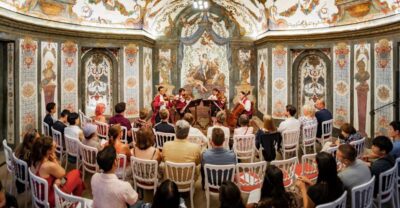
Browse the lists this tour appears in