
Reviewed · WALKING TOURS
Nuns and Nazis Walking Tour in Salzburg
Salzburg’s best-known movie is set against a cheerful backdrop of hills, music, and singing children. This tour asks you to look again. With guide Leo, you connect The Sound of Music with the darker story of Salzburg during World War II, including the Nazi takeover, forced labor, Jewish families, and the Trapp family’s real experience.
I like the way the tour joins two subjects that are usually treated separately. I also like the personal angle: Leo’s family history was shaped by the war, so the walk is not simply a list of dates. The main drawback is the pace and length. It lasts at least two hours, can run closer to three, and includes a walk uphill to Nonnberg Abbey.
Key points to know before you book
- The movie and the war share the same streets: You’ll visit Mirabell Gardens, the Festspielhaus, Residenzplatz, and Nonnberg Abbey while hearing what happened in those places during the Nazi era.
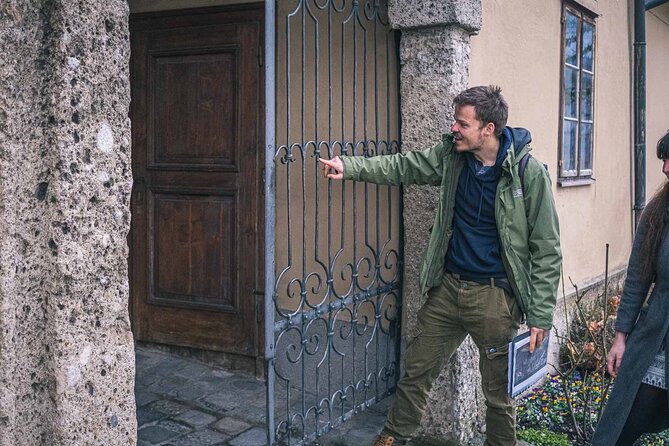
- Leo leads the walk: His family connection to World War II gives the subject a personal frame, while his Sound of Music knowledge adds the film details.
- The route ends at Nonnberg Abbey: From here, you can continue toward Hohensalzburg Fortress or enjoy the Alpine view.
- Expect a serious history lesson: The tour covers Stolpersteine, forced labor, the Anschluss, book burning, Jewish families, and the Trapp family’s departure.
- The tour is good value at $20.64: You receive roughly two hours or more of guiding through central Salzburg, with no separate admission fees listed for the stops.
- Plan for weather and walking: The group can include up to 25 people, the tour runs at 3 p.m., and moderate physical fitness is recommended.
Why the Nuns and Nazis theme works in Salzburg
The unusual title makes sense once you understand the route. The nuns refer mainly to Nonnberg Abbey and the famous opening and closing threads of The Sound of Music. The Nazis refer to the political and social reality surrounding Salzburg during World War II.
The point is not to turn the movie into a history lesson or the war into movie trivia. Instead, you see how the two stories overlap. The Trapp family really was connected with Salzburg’s musical life. The family’s departure also belongs to the history of a city taken over by Nazi Germany.
I appreciate this focus because a standard Salzburg walk often concentrates on Mozart, baroque architecture, and the old town’s good looks. Those subjects matter, but they can leave you with a polished picture of the city. This tour adds the difficult questions. What happened to Jewish families? How did ordinary people respond? What changed after the Anschluss? Who built the city’s wartime infrastructure?
The tone appears to balance seriousness with warmth. Leo is described as cheerful, professional, and passionate about Salzburg, but the subject itself is not light. You should book this walk if you want a thoughtful look at the city, not simply a procession of filming locations.
More Walking Tours in Salzburg
- Salzburg 2.5-Hour Walking Tour: Mozart, Old Town & More
★ 4.2 · 987 reviews - Salzburg: Old Town, Mozart, & Mirabell Gardens Walking Tour
★ 4.8 · 461 reviews - Salzburg Oldtown: Sightseeing Walking Tour with Licensed Local Guide
★ 5.0 · 392 reviews
Starting among the flowers at Mirabell Gardens
The walk starts at Kurgarten on Rainerstraße at 3 p.m. From there, the group crosses Mirabell Gardens, one of Salzburg’s best-known Sound of Music locations.
This is a pleasant opening because the gardens give you familiar visual territory before the history becomes heavier. If you have seen the film, you may recognize the setting from the song and dance sequence. If you have not, the gardens still provide an attractive beginning in central Salzburg.
The stop lasts about 15 minutes and has no admission charge. Keep your attention on the guide rather than treating this as a photo stop alone. The larger idea begins here: Salzburg’s image as a city of music and beauty existed alongside events that were anything but cheerful.
A practical tip is to watch The Sound of Music before the tour if the film is part of your reason for booking. Several locations appear only briefly, and a fresh memory of the movie will help you place the scenes. You can still enjoy the walk without seeing it, but the film connections will mean more if you recognize them.
Makartplatz and the changing names of a square
At Makartplatz, Leo uses the square’s changing names to show how public spaces can reflect political change. The name was altered several times before, during, and after World War II.
That may sound like a small detail, but it is a useful way to understand power. A government can change signs quickly. The names on a map can tell you who wanted to be remembered and which political message was being promoted at a given moment.
The stop also points to buildings affected by the war. You are not just hearing about distant events. You are looking at a square whose surroundings carry signs of the city’s changing fortunes.
The scheduled visit is about 10 minutes. That is enough for a focused explanation, though not enough for a long architectural survey. If you prefer tours that stay tightly centered on one subject, this is a good fit.
Linzergasse and Salzburg’s Stolpersteine
Linzergasse takes you into a former neighborhood of ordinary residents. Here, Leo introduces the Stolpersteine, small memorial stones placed for victims of the Nazi regime.
This is one of the most meaningful parts of the walk because the memorials bring the subject down to an individual scale. A broad discussion of persecution can become abstract. Names and personal markers make it harder to treat the past as something that happened only in textbooks.
The stop lasts around 10 minutes. You will learn about the people represented by the stones and how Nazi persecution affected Salzburg residents. The tour’s focus on common people is important. The story is not limited to famous leaders, soldiers, or the Trapp family.
Look down as you walk through Linzergasse. The memorials may be easy to miss if you are focused on shopfronts or old buildings. This is also a point where the tour asks for a respectful attitude. It is not a theatrical crime story. It is a public remembrance of real victims.
More walking routes in Salzburg:
- Salzburg Old Town Walking Tour, Mozart, Mirabell Gardens
★ 4.5 · 201 reviews - Salzburg Old Town Highlights Private Walking Tour
★ 4.5 · 78 reviews - Salzburg Private Walking Tour
★ 4.6 · 48 reviews - Private Walking Tour of Salzburg
★ 5.0 · 42 reviews
Steingasse and an uncertain wartime story
Steingasse brings a change of tone. Leo tells an urban legend about a particular trace of World War II in Salzburg, then leaves you to decide how much of it you believe.
That kind of story can be useful when handled carefully. War leaves behind facts, rumors, gaps, and local tales. By labeling this as an urban legend rather than presenting it as proven fact, the tour gives you room to think about how stories develop.
The stop takes about 10 minutes. You should not expect a definitive historical claim here. Consider it a short pause from the documented subjects and a reminder that old cities collect stories around unusual places.
For some people, this will be a charming part of the walk. If you prefer every minute to focus on firmly established evidence, it may feel less essential than the Stolpersteine or Residenzplatz. That is a fair trade in a tour that aims to show both history and local memory.
Staatsbrücke and the hidden labor behind a bridge
At Staatsbrücke, Salzburg’s main old-town bridge, the subject becomes especially concrete. Hundreds of prisoners of war and forced laborers worked on its construction during World War II.
A bridge looks ordinary once it is finished. You cross it to reach another part of town and rarely ask who built it or under what conditions. This stop changes that habit. It connects the visible city with the people whose labor was taken from them.
The visit lasts about 10 minutes. The subject is serious, and it adds an important social layer to the tour. The war was not only fought at the front. It altered workplaces, buildings, families, and daily life in cities far from the main battle lines.
This is one reason I would not describe the experience as a standard Sound of Music tour. The film gives you recognizable places, but the walk repeatedly asks you to look past the postcard view.
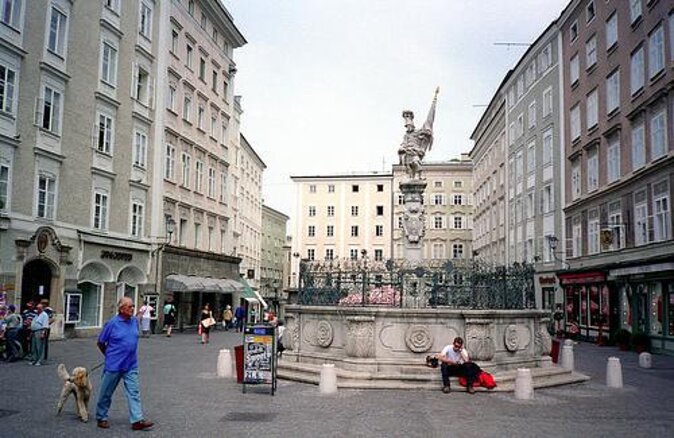
Alter Markt and the choices facing Jewish families
At Alter Markt, Leo tells stories about ordinary Salzburg residents and a Jewish family trying to escape before the Nazis took power. Some escaped. Others did not.
This stop brings the political story into personal decisions. Leaving home, finding a route out, and deciding whether danger had become serious enough to act were not simple choices. The tour does not treat the past as if everyone knew exactly what was coming.
Alter Markt is also a useful setting because it keeps the focus on daily life. A square is not only a ceremonial place. It is where people worked, shopped, met friends, and tried to carry on as political conditions changed.
The scheduled time is about 10 minutes. You will not receive a full account of every Jewish family in Salzburg, but you will get a human-scale example of what the Nazi rise meant locally.
The Festspielhaus and the Trapp family’s real stage
The Grosses Festspielhaus is where the movie shows the Trapp family performing before fleeing Salzburg. The family really did perform there, which makes the location more than a film set.
This is one of the tour’s strongest links between screen and history. The Sound of Music uses real places, but the film also reshapes events for storytelling. Leo helps separate the actual family story from the version presented on screen.
The visit lasts around 15 minutes. If you love the movie, this will likely be a highlight. You’ll see where the concert sequence was placed in the film and hear how the Trapp family’s musical life connected with Salzburg.
The building also carries a political context. The arts do not float above history. Concert halls, festivals, and public performances exist within the political world around them. That makes the Festspielhaus a useful stop for both movie fans and people interested in Salzburg’s cultural life.
Residenzplatz, the Anschluss, and Salzburg’s book burning
Residenzplatz is the main square of Salzburg’s old town and the longest stop on the route, at about 20 minutes. Here, Leo explains the Anschluss, the Nazi takeover of Austria, more of the Trapp family story, and the film’s treatment of events.
You also hear about the only book burning that took place in Salzburg during World War II. That detail gives the square a direct connection to the suppression of ideas and public culture.
This is likely the tour’s central history stop. The earlier locations introduce memorials, buildings, labor, and personal stories. Residenzplatz brings those threads together in a major public space.
The square can be busy with everyday sightseeing, so staying close to Leo matters. With a maximum group size of 25, the walk is not private, but it should remain manageable. You may want to stand where you can hear clearly rather than chasing the best photograph.
The final climb to Nonnberg Abbey
From Residenzplatz, the route continues to Stift Nonnberg. The abbey is associated with The Sound of Music, but its importance goes far beyond the movie. It is described as the oldest women’s monastery in the world.
This final section gives the tour a sense of place. The walk leaves the main square and heads toward a less familiar Salzburg sight. You finish with more Sound of Music details and stories, along with a view toward the Alps.
The stop takes about 20 minutes. The route is not simply flat city walking, and the recommendation for moderate physical fitness matters. If you have mobility concerns, consider the walk’s length and its uphill finish before booking.
Nonnberg Abbey is also a practical ending point. The church is worth seeing, and you can continue on foot toward Hohensalzburg Fortress. If the tour has run longer than two hours, you may prefer to pause at the abbey rather than add another major sight immediately.
Price, length, and group size
At $20.64 per person, this is a strong value for a specialized walking tour. The price is close to a casual meal or a short paid attraction, but here it covers roughly two hours to two hours and 15 minutes of guiding through central Salzburg. The stops themselves are listed as free, so you are paying mainly for interpretation and local knowledge.
Allow extra time. The official duration is approximately two to two hours and 15 minutes, while one account describes a tour lasting about three hours. That may depend on questions, group pace, weather, and how much Leo has to explain. Do not schedule a tight late-afternoon appointment immediately afterward.
The group can include up to 25 people. That is not an intimate private walk, but it is still small enough for a guide-led route through the old town. Service animals are allowed, and the starting point is near public transportation.
The tour runs at 3 p.m., which makes it easy to place after a morning sightseeing schedule. Salzburg’s weather can change, so bring clothing suitable for standing and walking outside. One account describes a cold, rainy day, yet the guide kept the experience engaging. You should still prepare for the conditions rather than count on good weather.
Free cancellation is available if you cancel at least 24 hours before the start time. Changes or cancellations inside that window are not accepted for a refund.
Who will enjoy this walk most
I would choose this tour if you have at least one of these interests:
- The Sound of Music and its filming locations
- Salzburg during World War II
- The Trapp family’s real story
- Jewish life and Nazi persecution in Austria
- Memorials, public memory, and local history
- Walking tours led by a guide with a personal connection to the subject
It is especially useful after a general Salzburg walking tour. The standard city overview helps you recognize the streets and major sights. This walk then gives those places a more specific historical purpose.
You do not need to be a serious World War II student. Leo’s approach includes film, family stories, urban legends, and city landmarks, so the subject should remain accessible. Still, you should be comfortable with difficult material. The tour deals with persecution, forced labor, escape, and political takeover. It is not a light afternoon entertainment package.
Should you book the Nuns and Nazis Tour?
Book it if you want Salzburg to be more than a beautiful backdrop for Mozart and The Sound of Music. For $20.64, you get a focused route, a guide named Leo who brings personal interest to the subject, and a useful connection between the city’s cheerful image and its wartime past.
Skip it if you want a short, purely cheerful movie tour, or if you need to keep the afternoon on a strict schedule. The walk can last longer than advertised, and the route ends with an uphill section at Nonnberg Abbey.
My advice is to watch The Sound of Music beforehand, wear comfortable shoes, allow three hours, and keep the rest of your afternoon flexible. If you do that, this tour offers one of the clearest ways to see Salzburg as both a movie setting and a real city shaped by World War II.
FAQ
Where does the Nuns and Nazis Walking Tour start?
The tour starts at Kurgarten, Rainerstraße 2, 5020 Salzburg, Austria.
What time does the tour begin?
The scheduled start time is 3 p.m.
Where does the tour end?
The tour ends at Nonnberggasse 8, near Nonnberg Abbey.
How long does the tour last?
The estimated duration is two hours to two hours and 15 minutes. You should allow extra time because one account describes the walk lasting about three hours.
How much does the tour cost?
The listed price is $20.64 per person.
What places does the tour visit?
The route includes Mirabell Gardens, Makartplatz, Linzergasse, Steingasse, Staatsbrücke, Alter Markt, the Grosses Festspielhaus, Residenzplatz, and Nonnberg Abbey.
Is the tour mainly about The Sound of Music?
It covers The Sound of Music and the Trapp family, but it also focuses on Salzburg during World War II, including the Nazi takeover, Stolpersteine, forced labor, Jewish families, and book burning.
How large can the group be?
The tour has a maximum of 25 participants.
Can I cancel for a full refund?
Yes. You can cancel at least 24 hours before the experience start time for a full refund. Cancellations or changes made less than 24 hours before the start are not refunded or accepted.
Just added in Salzburg
- Zell am See Alpine Village Private Day Trip from Salzburg★ 5.0 · 3 reviews
- Werfen World’s Largest Ice Caves and Golling Waterfalls Tour★ 4.5 · 7 reviews
- Musical Salzburg: Follow the Trail of the Beloved Movie★ 5.0 · 5 reviews
- Private transfer from Salzburg to Vienna, 2 hours for sightseeing★ 4.5 · 7 reviews
- Viator Exclusive: ‘The Sound of Music’ Private Tour★ 5.0 · 28 reviews
- Salzburg Marionette Theater: The Magic Flute SHORT version (1 hour)★ 5.0 · 11 reviews
- Private Transfer from Salzburg to Munich with 2 hours for sightseeing★ 5.0 · 8 reviews
- Private Austrian Food Tasting Tour in Salzburg’s Old Town★ 4.5 · 3 reviews
Walking Tours, compared.
Guided Walking Tour of City Center Highlights
Read our review →
Guided Walking Tour of City Highlights & Hidden Gems
Read our review →
Vienna Historic Center Small Group Walking Tour
Read our review →
Browse the lists this tour appears in